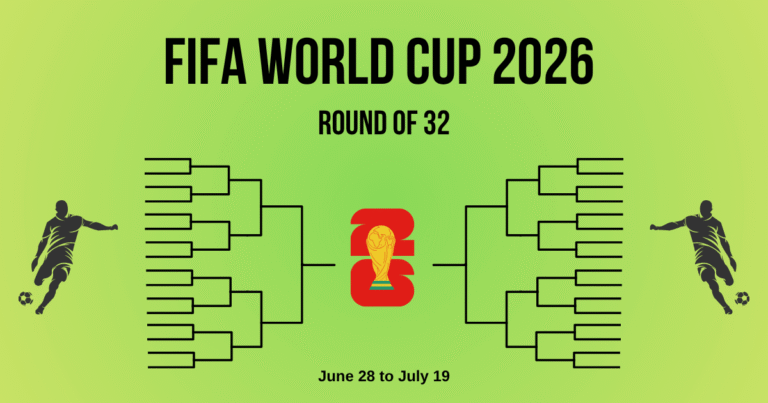
World Cup 2026 Knockout Stage Explained: Round of 32 to the Final
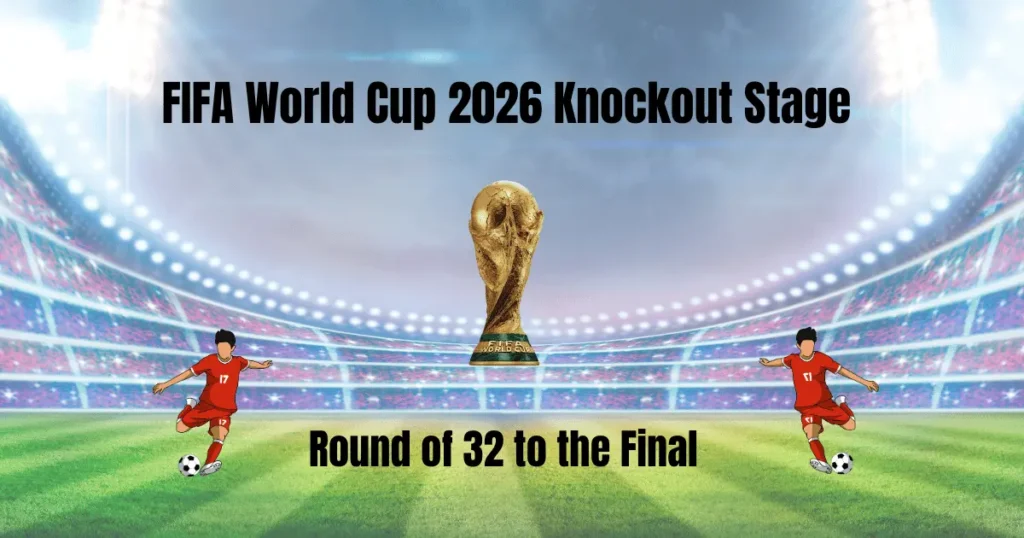
The World Cup 2026 knockout stage runs from June 28 to July 19, 2026, and for the first time in tournament history it opens with a Round of 32 before the Round of 16, quarterfinals, semifinals, and final. Thirty-two of the 48 teams reach this stage, and from here every match is win or go home.
This guide walks you through the full knockout timeline, how the bracket works, the new Round of 32, the tiebreaker rules, and every round on the road to the final in New York and New Jersey.
| Round | Dates (2026) | Matches |
|---|---|---|
| Round of 32 | June 28 to July 3 | 16 |
| Round of 16 | July 4 to July 7 | 8 |
| Quarterfinals | July 9 to July 11 | 4 |
| Semifinals | July 14 to July 15 | 2 |
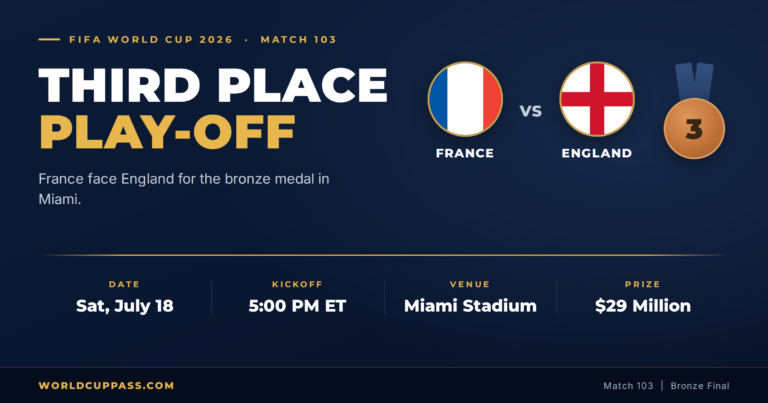
| Third-Place Playoff | July 18 | 1 |
| Final | July 19 | 1 |
World Cup 2026 Knockout Stage Schedule
The knockout stage starts the day after the group stage ends on June 27, so the Round of 32 kicks off on June 28. Five rounds follow over roughly three weeks, finishing with the final on July 19. In total you get 32 elimination matches, more than any World Cup before, because the expanded 48-team format added a whole extra knockout round.
Kickoff times are spread across the day to suit audiences in three host countries and TV markets worldwide. For exact kickoff times in your timezone, along with the venue for every fixture, check the full World Cup 2026 schedule.
Bookmark this page too, because the bracket here is updated as each round is decided.
How the World Cup 2026 Knockout Stage Works
Once the group stage ends, the World Cup switches from a points table to straight knockout football. There are no more draws and no second chances. You win, or you are out. Every team that reaches this stage is one of the best 32 in the world, so the margins get thin and a single mistake can end a campaign.
The path to the trophy now runs through five rounds: the Round of 32, the Round of 16, the quarterfinals, the semifinals, and the final. A champion has to win five knockout matches in a row, one more than at any previous World Cup. The two losing semifinalists meet in a third-place playoff, while the winners go on to the final.
This is the longest and most demanding knockout run the tournament has ever staged. With 32 elimination games packed into about three weeks, fitness, squad depth, and a little luck in the shootout lottery all matter more than they ever have.
How Teams Qualify for the Round of 32
The group stage features 12 groups of four teams. The top two from every group advance automatically, which gives you 24 qualifiers. The final eight spots go to the best third-placed teams across all 12 groups, bringing the total to 32 and filling out the Round of 32 bracket.
To rank the third-placed teams, FIFA compares points first, then goal difference, and then goals scored. A strong third-place finish can still book a knockout place, so the race for those eight spots stays alive right up to the last group games. You can follow it on the live World Cup 2026 standings.
Because the eight qualifying third-placed teams can come from different group combinations, the exact Round of 32 matchups are not fixed in advance. FIFA published 495 possible combinations in the tournament regulations to cover every scenario, and the bracket only locks once the group stage is complete.
The New Round of 32 Explained
The Round of 32 is the biggest structural change at this World Cup, and it has never existed before. At every tournament from 1998 through 2022, only 16 teams reached the knockout stage, so the first knockout round was the Round of 16. With 48 teams now in the field and 32 advancing, that extra opening round was needed.
For players, it means one more match to survive before the stages fans know well. For you as a viewer, it means a packed first week of knockout football, with 16 matches squeezed into six days.
For a full breakdown of fixtures, dates, and bracket slots, see our dedicated World Cup 2026 Round of 32 guide.
World Cup 2026 Knockout Bracket Explained
The knockout bracket is built around two halves, often called pathways. The draw and seeding are designed to keep the highest-ranked teams apart for as long as possible, so the strongest sides cannot meet until the semifinals at the earliest. Where your team lands depends on whether it wins its group or qualifies as a runner-up or third-placed side.
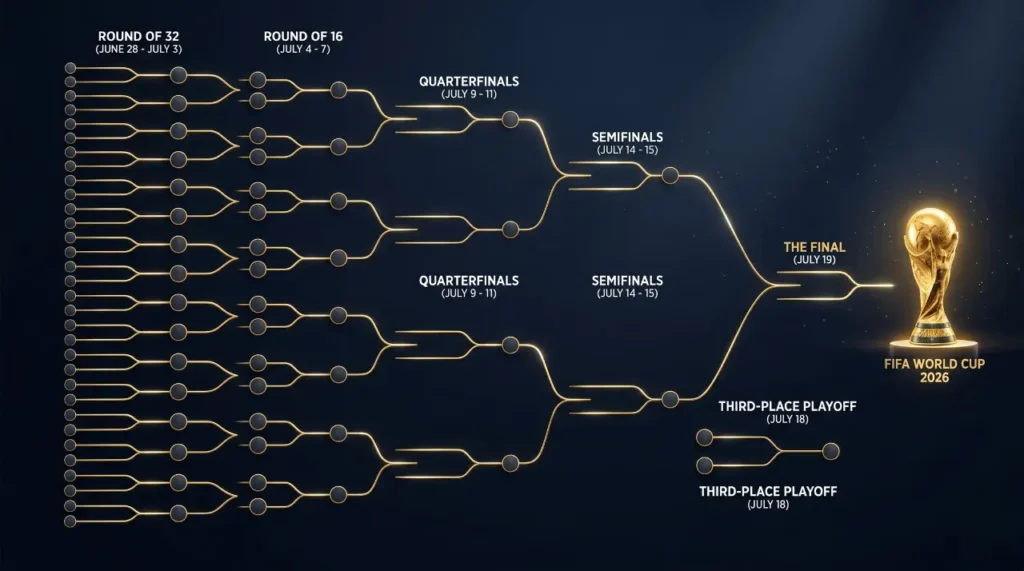
Once you know a team’s group finish, you can trace its possible route all the way to the final. To map out paths and test different scenarios yourself, use the interactive World Cup 2026 bracket and the simulator, which let you pick winners round by round and see who would meet next.
World Cup 2026 Knockout Stage Rounds
Here is how each round of the knockout stage breaks down, with a link to the full guide for every stage.
Round of 32 (June 28 to July 3)
The first knockout round brings 16 matches over six days. The 32 qualifiers are paired into single-elimination ties, and the 16 winners move on while the rest go home. This is the round where the field is cut in half for the first time.
Full details: World Cup 2026 Round of 32.
Round of 16 (July 4 to July 7)
Eight matches across four days. The surviving 16 teams meet, and the eight winners reach the quarterfinals. By this point every remaining side is a genuine contender, and the football tightens.
Full details: World Cup 2026 Round of 16.
Quarterfinals (July 9 to July 11)
Four matches send the winners into the semifinals. The quarterfinals often produce the tightest games of the tournament, with elite teams separated by fine margins and, in many cases, penalties.
Full details: World Cup 2026 Quarterfinals.
Semifinals (July 14 to July 15)
The last four teams meet in two matches. The winners advance to the final, and the losers drop into the third-place playoff. The pressure here is unlike anything earlier in the bracket.
Full details: World Cup 2026 Semifinals.
Third-Place Playoff (July 18)
The two losing semifinalists play a single match to decide who finishes third. It is the final chance for a podium place before the showpiece, and it often turns into an open, high-scoring game.
The Final (July 19)
The World Cup 2026 final is on July 19 at MetLife Stadium in New Jersey, listed by FIFA as New York New Jersey Stadium, with a capacity of 82,500. The two semifinal winners play for the trophy in front of a global audience.
Full details: World Cup 2026 Final.
What Happens If a Knockout Match is a Draw
Knockout matches cannot end level. If the score is tied after 90 minutes, the match goes to extra time, played as two 15-minute halves. There is no golden goal, so both halves are always completed in full even if a team scores early in the period.
If the teams are still level after extra time, the match is decided by a penalty shootout. Each side takes five penalties, alternating kicks. If the score remains tied after those, the shootout moves to sudden death, one round of kicks at a time, until one team scores and the other misses.
Where the World Cup 2026 Knockout Matches Are Played
The Round of 32 and Round of 16 are spread across host cities in all three countries, the United States, Canada, and Mexico, the same nations that staged the group phase. Round of 16 matches are still played in Vancouver and Mexico City alongside US venues, so the early knockout football stays spread across the continent.
From the quarterfinals onward, the tournament moves entirely to the United States. Every quarterfinal, both semifinals, the third-place playoff, and the final are held at US stadiums. The final takes place on July 19 at MetLife Stadium in East Rutherford, New Jersey, inside the New York metropolitan area. FIFA refers to it as New York New Jersey Stadium for the tournament, and it seats 82,500 for the World Cup.
How to Watch the World Cup 2026 Knockout Stage
Every knockout match is broadcast on television and streamed online, so you can follow all 32 games wherever you are. Coverage varies by country, with different broadcasters and streaming platforms holding the rights in each market. The later the round, the bigger the audience, and the final draws one of the largest live viewerships in all of sport.
For a country-by-country breakdown of channels and streaming options, including free and paid services, see our how to watch World Cup 2026 guide. It covers the knockout stage and the final in detail, so you can lock in your viewing plan before kickoff.
FAQ About the World Cup 2026 Knockout Stage
Can two teams from the same group meet again in the knockout stage?
Yes. Once the knockout bracket begins, group affiliations no longer matter. Two teams that played each other in the group stage can be drawn together again at any knockout round, including the final, if their results send them down the same side of the bracket. There is no rule keeping former group rivals apart.
When do yellow cards reset in the World Cup 2026 knockout stage?
For the first time, single yellow cards are wiped twice at this World Cup: once after the group stage and again after the quarterfinals. FIFA added the second reset because the new Round of 32 made the run to the final longer.
A group-stage booking does not carry into the knockout rounds, and no player can miss the final over earlier single yellows. Red card suspensions still apply.
Is VAR used in the World Cup 2026 knockout stage?
Yes. Video Assistant Referee technology is used in every knockout match, just as it is in the group stage. VAR can review goals, penalty decisions, direct red cards, and cases of mistaken identity.
In the tight margins of knockout football, these reviews often decide which team advances and which one goes home.
How many rest days do teams get between knockout rounds?
It varies by round and fixture. Teams usually get around three to four days between the Round of 32 and the Round of 16, with similar gaps deeper in the bracket. Exact rest depends on which day a team plays, so two sides in the same round can reach their next match with different amounts of recovery time.
What happens if a knockout match is abandoned?
If a knockout match is abandoned, FIFA decides the outcome under its regulations, which can include resuming or replaying the match. The governing body handles each case individually based on the reason and the timing. These situations are very rare, and the priority is always to complete the fixture so a winner can advance.
Do knockout matches use the same kickoff times as the group stage?
Not always. Kickoff times in the knockout stage are set to reach the widest possible audience across host countries and global TV markets. As the rounds progress and fewer matches are played each day, the biggest fixtures are often scheduled in prime viewing windows. Check the schedule page for the exact time of each match.